

Press
Facts, assets, and how to describe Run Late.
Alarms wake you up. This one gets you out.
Run Late is a departure alarm for people who wake up on time and still leave late. At the exact minute you need to leave, it takes over the screen — no snooze, no off button. The only way to shut it off is to walk out the door.

Why a departure alarm
Nobody in the stories overslept.
The pattern came from colleagues describing the same morning, over and over. They were up on time. Then one more video. Then one more. Then a last-second trip to the bathroom — and the bus was gone. None of those mornings was a failure to wake up. Every one of them was a failure to leave.
For most commuters the wake-up time is already the steady number. The wildcard is the minute you actually walk out: 8:04, 8:19, 8:31. So Run Late does not try to overhaul your morning. It fixes that one variable, and it holds it by refusing to end until GPS confirms you are 150 feet from your door.
The app measures the thing it was built to fix. The Log tab scores how consistent your last ten departures were, not just whether you kept a streak.
How to describe Run Late
- The alarm with no off button
- An alarm that won't stop until you physically leave the house
- A departure alarm: the first alarm built for leaving, not waking
- A GPS-powered commitment device disguised as an alarm clock
Fact sheet
- App
- Run Late — "No off button · leave on time"
- Developer
- Taehee Lee (@elate.lee) — one-person studio, Seoul. Published by TIVIA Inc.
- Released
- August 28, 2026 (iOS) · September 15, 2026 (Android)
- Platform
- iPhone, iOS 26+ — built on Apple's AlarmKit framework. Android 8.0+ — the same app, rebuilt on AlarmManager and a full-screen intent
- Price
- $29.99/year with a 7-day free trial, or $5.99/month (no trial). Founding members who joined by October 18, 2026 keep $19.99/year for life.
- Press contact
- support@runlate.app
By the numbers
- 55.6%
- of 3M+ analyzed sleep sessions end with the snooze button (Scientific Reports, 2025 — Mass General Brigham) — source
- 11 min
- lost to snoozing per morning by heavy snoozers, on average (same study) — source
- 150 ft
- the GPS-verified distance from your front door that ends the alarm (50 m in metric countries)
- 0
- off buttons, snooze buttons, and guilt notifications in the app
- 6
- App Store rejections before it shipped
How the alarm ends
- Departure time, calculated backwards. It fires at your leave time — worked back from your target arrival and the door-to-door commute.
- The 150-foot rule. The default mission is 150 feet (50 m) from your front door, verified by GPS, adjustable up to 450 feet (150 m). For high-rises, garages and hallways where GPS is weak, an alarm can use Steps mode instead: 50, 100 or 150 counted steps, with the camera showing the path ahead.
- Nothing to negotiate with. No snooze and no dismiss button, by design. Skipping a day is allowed — but only before the alarm fires.
- You can outlast the sound. You can't outlast the record. If the sound runs out or you force-quit the app, the morning is logged INCOMPLETE anyway. Every entry in the history is measured, never self-reported.
Why now — what Apple unlocked
Until iOS 26 there was no honest way to build this. Third-party alarm apps ran on workarounds: they looped background audio and hoped, and broke the moment the phone locked or the app was swiped away. AlarmKit, introduced at WWDC25, gave third-party alarms system-level standing — full volume through silent mode and Focus, and firing with the app force-quit. Run Late has been built on it since day one, which is why it requires iOS 26.
iOS 27 went a step further and gave alarms a volume of their own, separate from the ringtone (Settings → Sounds & Haptics → Alarms and Timers).
Read together, the direction is clear: Apple is turning the alarm from a sound into a system. Each step makes a departure alarm more possible than it was the year before.
See it happen — two ways out
The mission has two completion modes, and the user picks one. Both end the same way: the alarm stops itself, and the morning is written to the record.
Quotes
"It's not an alarm clock. It's a departure alarm. Waking up was never the hard part."— Taehee Lee (@elate.lee), founder
"It doesn't yell at you. It just doesn't stop."— Taehee Lee (@elate.lee), founder
"I started out building a reminder app. Three apps later, I know reminders don't work. They inform you, then they vanish. At 8:10 in the morning you don't need information. You need friction."— Taehee Lee (@elate.lee), founder
Coverage
- NextReview · Korea · Sep 23, 2026“Run Late: the anti-tardiness alarm that only turns off once you leave the house”Headline translated from Korean.
Who makes it
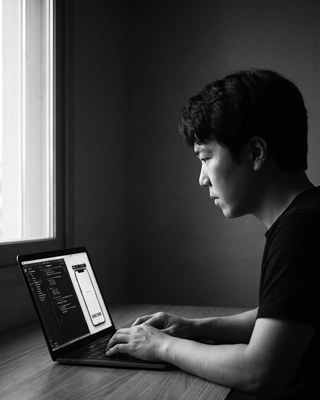
Taehee Lee — @elate.lee — is a one-person studio in Seoul, and does all of it: writes the code, designs the screens, buys the ads. Run Late is the third app in a row arguing the same thing, and each one has been less willing to take a user's word for it.
Founder note
For a long time I thought I was the problem. Then I started listening to the people around me at the office, and they were all telling the same story, every morning, and it was never the story you would expect. Nobody said they had overslept. They said: I was up at seven. Then one more video. Then one more after that. Then — should I use the bathroom before I go? And by then the bus was gone.
My first app was a reminder app. Three apps later my conclusion is that reminding people is the easy half, and the half that doesn't work. What's missing at 8:10 in the morning isn't information. It's something that makes you move.
So Run Late doesn't inform you — it takes the screen, removes the off button, and ends only at the door. I built it alone in Seoul, aimed at the US, and Apple rejected it six times before it shipped. It's for everyone whose mornings fail in the ten minutes after the alarm was already turned off.
Story starters
- The five-day trial. Review it the way it's used: five mornings, one verdict. The guide below is a five-day plan. Promo codes on request.
- The science of not negotiating. Snooze research says mornings are lost to bargaining. Run Late is a commitment device, in the Thaler and Ariely line of research, that stakes location instead of money.
- The maker with a thesis. Three apps, each less willing to take your word for it: a reminder app, a to-do app you can't fake, and now an alarm you can't turn off. One person in Seoul wrote all of it — and buys the ads too.
- The tech. Built on AlarmKit, Apple's new iOS 26 alarm framework, from day one — with an iOS 26 floor to match. Android has no AlarmKit, so that layer was rewritten on AlarmManager exact alarms and a full-screen intent; everything above it is the same Dart code.
- Six rejections, none about the off button. Apple sent it back six times before it shipped. The citations were subscription disclosure and a paywall that would not load its prices. Not one of them was about the alarm you cannot turn off — the design was never what App Review objected to.
- The vocabulary already exists. Being late while wide awake has its own online vocabulary: time blindness, the friend who is perpetually twenty minutes out. Those readers recognise the problem on sight. Run Late is built for them. It is not a treatment and does not claim to be.
Review Run Late in five days
- Day 1 — Set the morning. Enter where you have to be and when. Run Late computes your leave time backwards. Everything else follows from that number.
- Day 2 — Meet the alarm. At your leave time it takes the screen. Try to turn it off. Screenshot yourself failing.
- Day 3 — The walk. Watch the counter climb to 150 feet. The alarm stops the moment you're verifiably out.
- Day 4 — Try to cheat. Pace your bedroom. The counter measures straight-line distance from home, so it barely moves. Write that sentence down.
- Day 5 — Read your record. Five measured mornings, none self-reported. File the verdict.
FAQ
What if I'm sick, or working from home?
Skip today with one toggle — before the alarm fires. After it fires, the only exit is the door. That asymmetry is the product.
Can I really not turn it off?
There is no button, no snooze, no secret gesture. The OS eventually times the sound out, and nothing stops you from killing the app — but either way the day is recorded INCOMPLETE. The app doesn't win by force. It wins by keeping score.
Where does my location go?
The walk is verified on the phone, and your home location and morning records stay on the device. To show weather, travel time and map previews, coordinates go to Apple's or Google's own services. There is no account and no sign-up, and nothing is sold. (Subscriptions run through RevenueCat; install measurement is anonymous and aggregate.)
Is this the app that charges you for snoozing?
No. Run Late never takes money for failing. There is no snooze to charge for.
Milestones
- Jul 2026
- Concept locked: departure, not waking. Every alarm wakes you up; none of them get you out.
- Aug 2026
- Six App Store rejections, six resubmissions.
- Aug 28, 2026
- Live on the App Store.
- Sep 15, 2026
- Live on Google Play. Same app, one person, both stores.
- Sep 23, 2026
- Product Hunt launch. Founding price $19.99/year through Oct 18.
Assets
Download the full press kit (ZIP, 20 MB)
One-sheets, 7 app screens, founder photos, app icon and wordmark, fact sheet. Or pick individually:
- One-sheet (PDF, dark + light) — also as PNG:dark ·light
- Screenshots & app icon (ZIP) — 7 screens in both appearances, each in an iPhone frame on a transparent background and again unframed for cropping
- App icon (1024 + 512 PNG) and wordmark (SVG) (ZIP)
- Founder photo — square, portrait, wide (ZIP)
- App preview video (MP4, 16 s)
- Review access — App Store promo codes or a Google Play tester invite on request: support@runlate.app
Boilerplate
Run Late is a departure alarm for people who wake up on time and still leave late. Released in August 2026 by TIVIA Inc., it replaces the off button with the front door: the alarm ends only when GPS confirms you've left. Run Late is available on iPhone (iOS 26+) and Android (8.0+) at runlate.app.