Reminders tell you when to leave. Run Late makes you leave.
You see a slip.
They see a pattern.
Run Late opens with a one-minute diagnosis. What it shows you next is below: two surveys of U.S. hiring managers and one peer‑reviewed experiment.
What a later start costs you
Started at 7 a.m.3.06
Started at 11 a.m.2.83
Conscientiousness score, 1 to 5. Both employees had the same 26-week record.
You did the same work.
They rated you lower.
Same output. Same eight hours. The one who started later was rated less conscientious.
Yam, Fehr & Barnes (2014) · Journal of Applied Psychology
What blocks a promotion
Showing up late62%
Vulgar language51%
Leaving early49%
Gossiping44%
Social media at work39%
Hiring managers who said it hurts your chances of a promotion
Cursing costs less.
Being late costs more.
Showing up late tops the list of what blocks a promotion. Cursing, leaving early, and gossiping all rank below it.
CareerBuilder / Harris Poll (2015) · 2,175 U.S. hiring managers
Run Late breaks the pattern at the front door. It rings at your departure time and doesn't stop until you're out.
Run Late is not affiliated with or endorsed by these researchers or institutions. All findings cited are from publicly available research.
How it works
Three steps. The last one happens outside.
01
Take the one-minute diagnosis
Tell Run Late when you need to arrive and how long the trip takes. You get your departure time: the exact minute you have to walk out.
A 9:00 arrival and a 40-minute trip put your departure time at 8:20 AM.
That's the app's example. Yours takes about a minute, free, no account needed.
02
The alarm takes over
At your departure time, it fires and fills the screen. No snooze. No dismiss. No negotiating with yourself at 8:04.
03
Walk out. It stops.
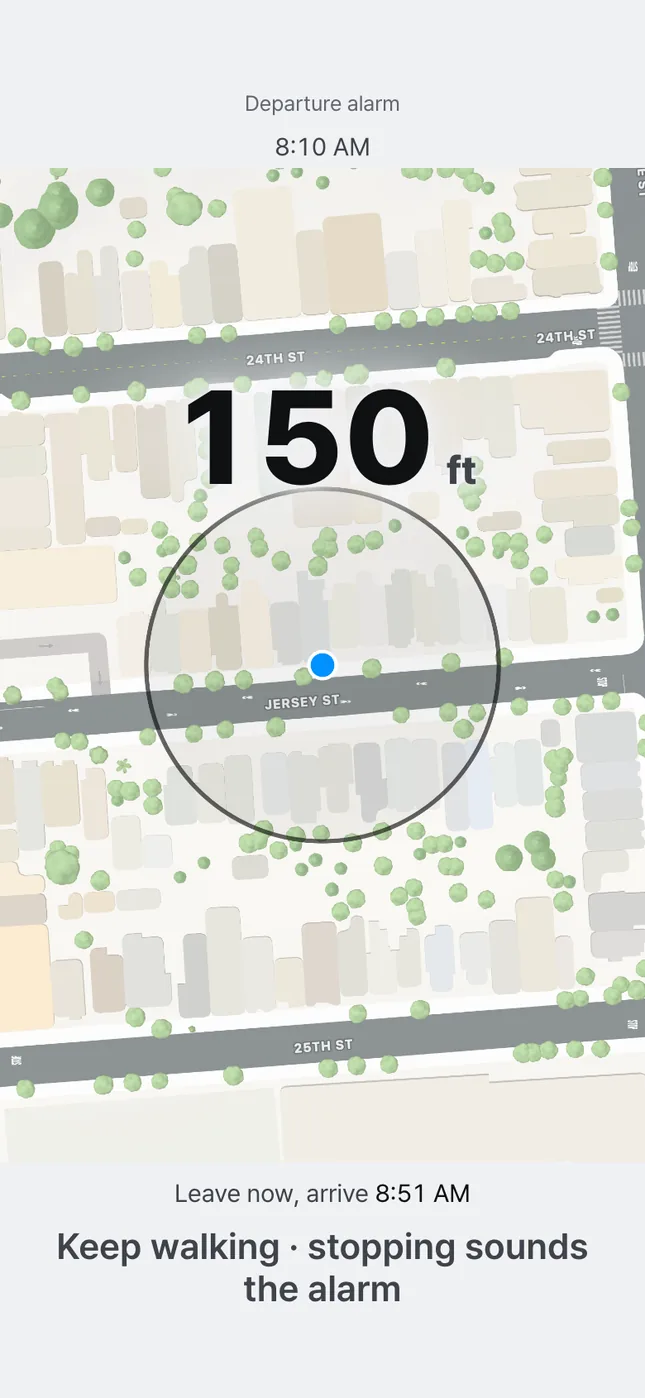
150 feet on the live map, or 50 steps with the camera on your path. Once Run Late confirms you left, the screen goes quiet.
Rain or shine, you still have to leave.
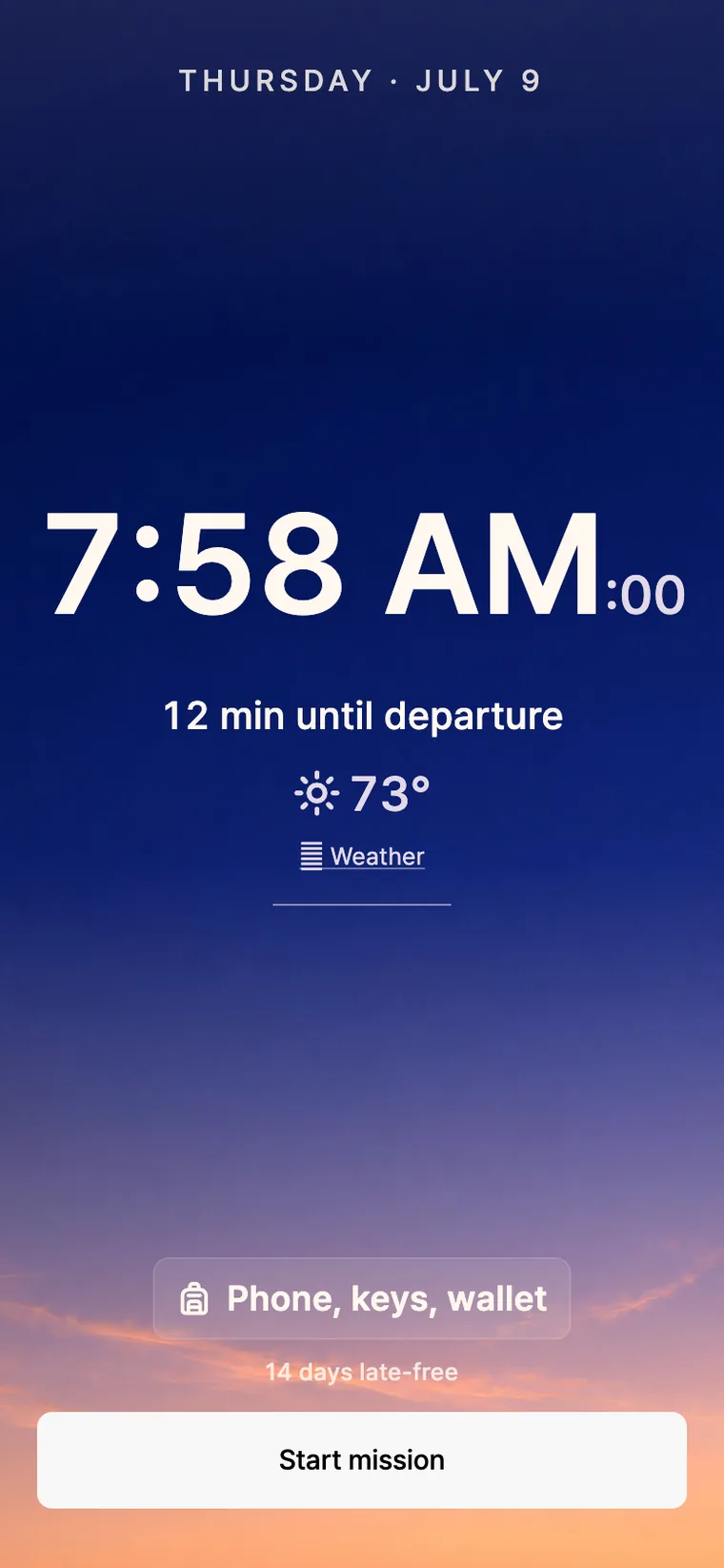
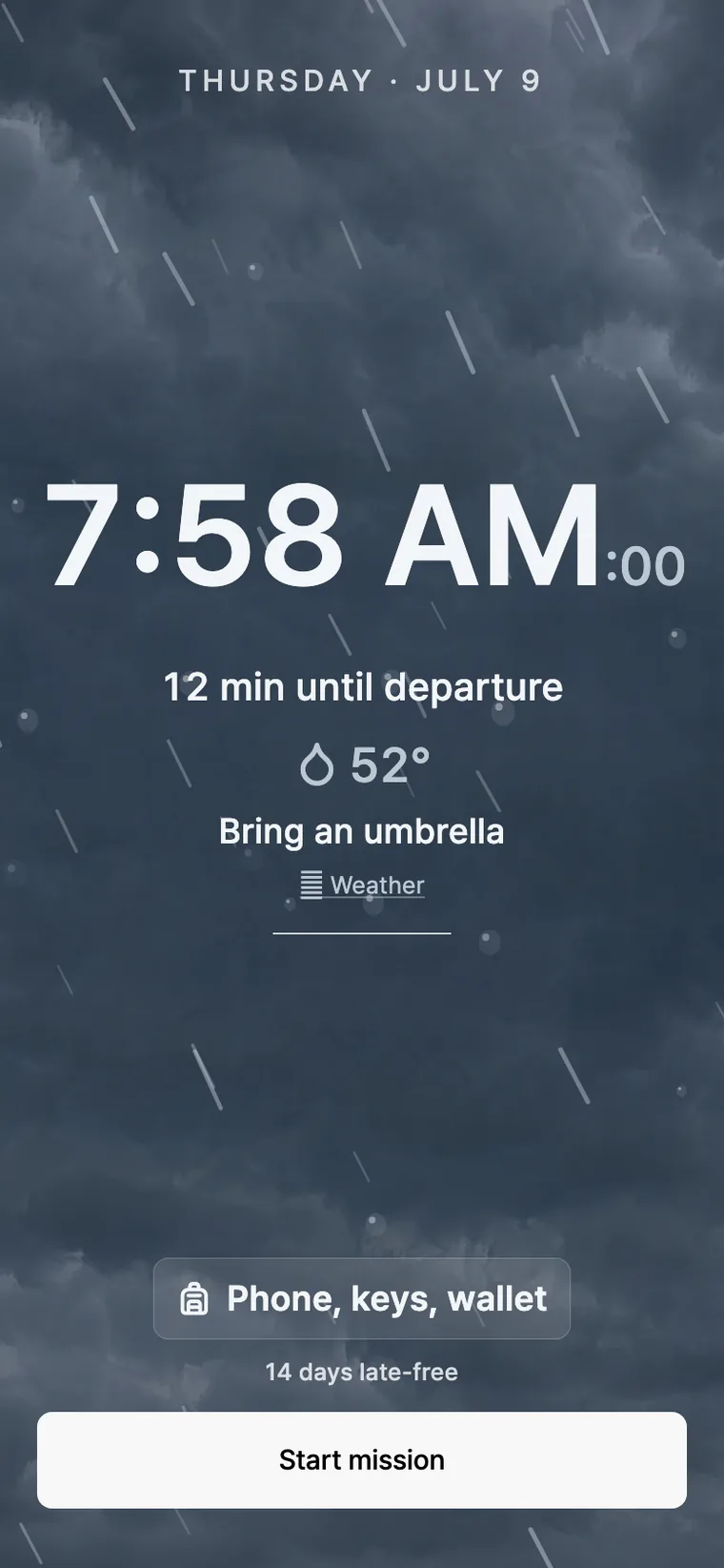
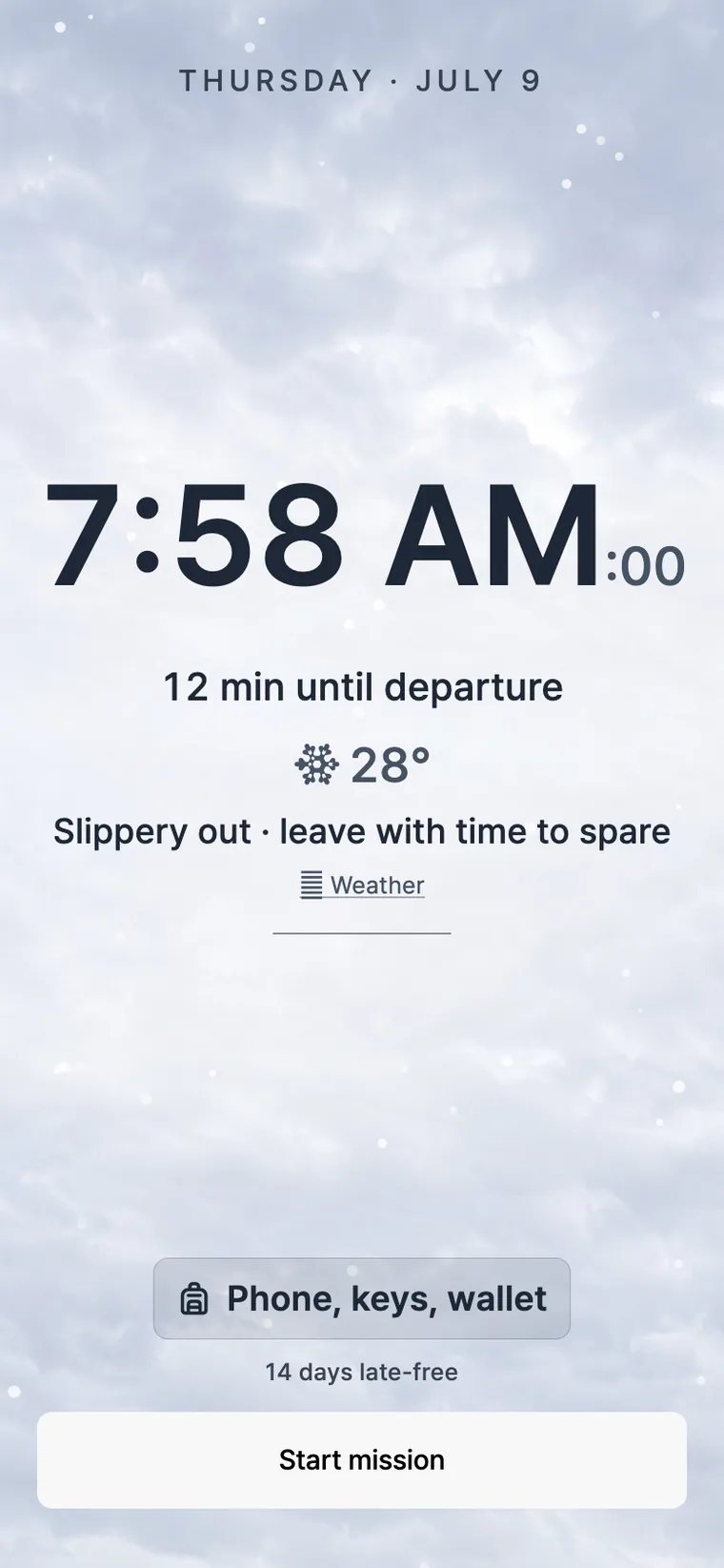
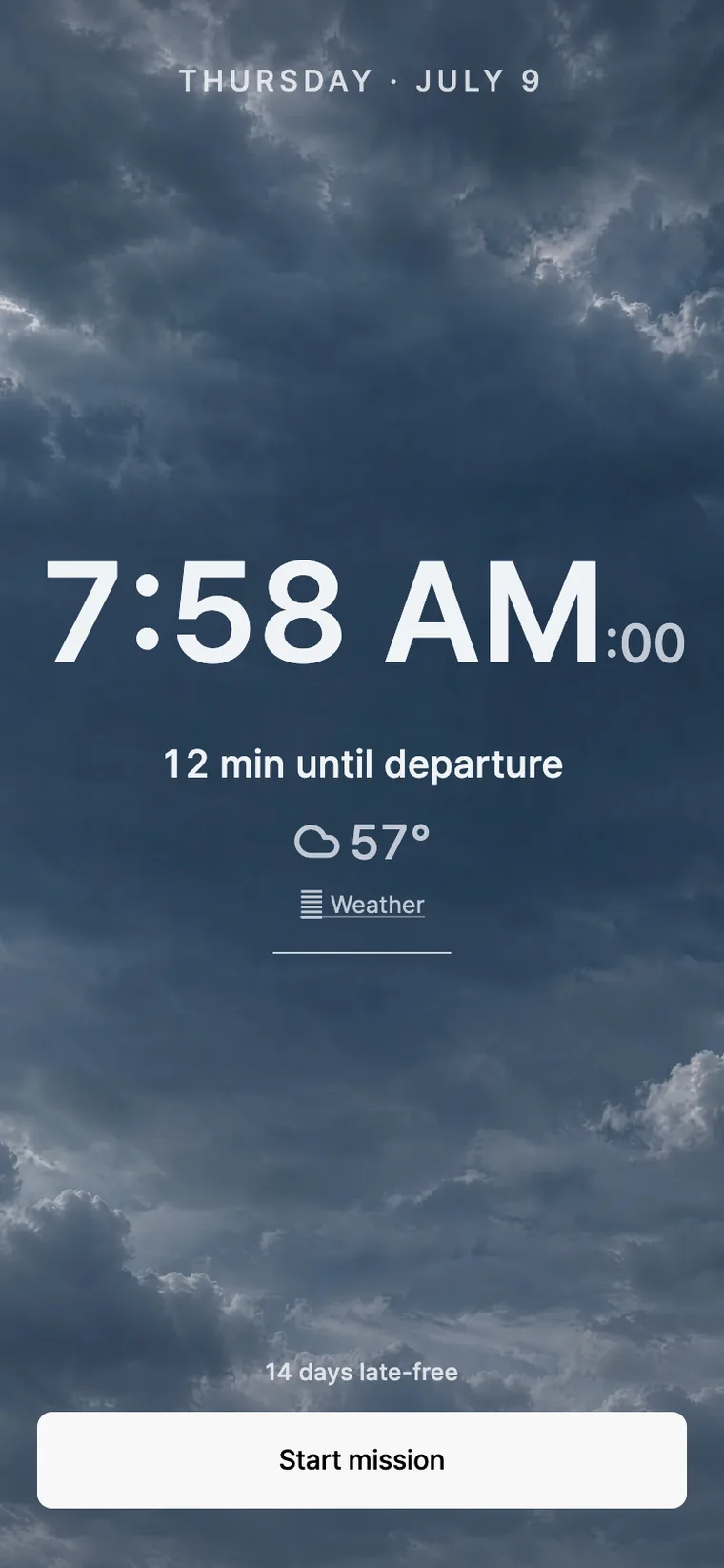
Twelve minutes before your departure time, the screen turns into this morning's sky: the actual temperature, what it means for your walk, and the short list you keep by the door. Then the alarm.
Clear · 73°
Rain · bring an umbrella
Snow · leave with time to spare
Overcast · 12 minutes to go
The forecast changes what you bring. It doesn't change when the bus leaves.
See it in action
Two ways out. Same ending.
Distance mission · live GPS mapSteps mission · camera on your path
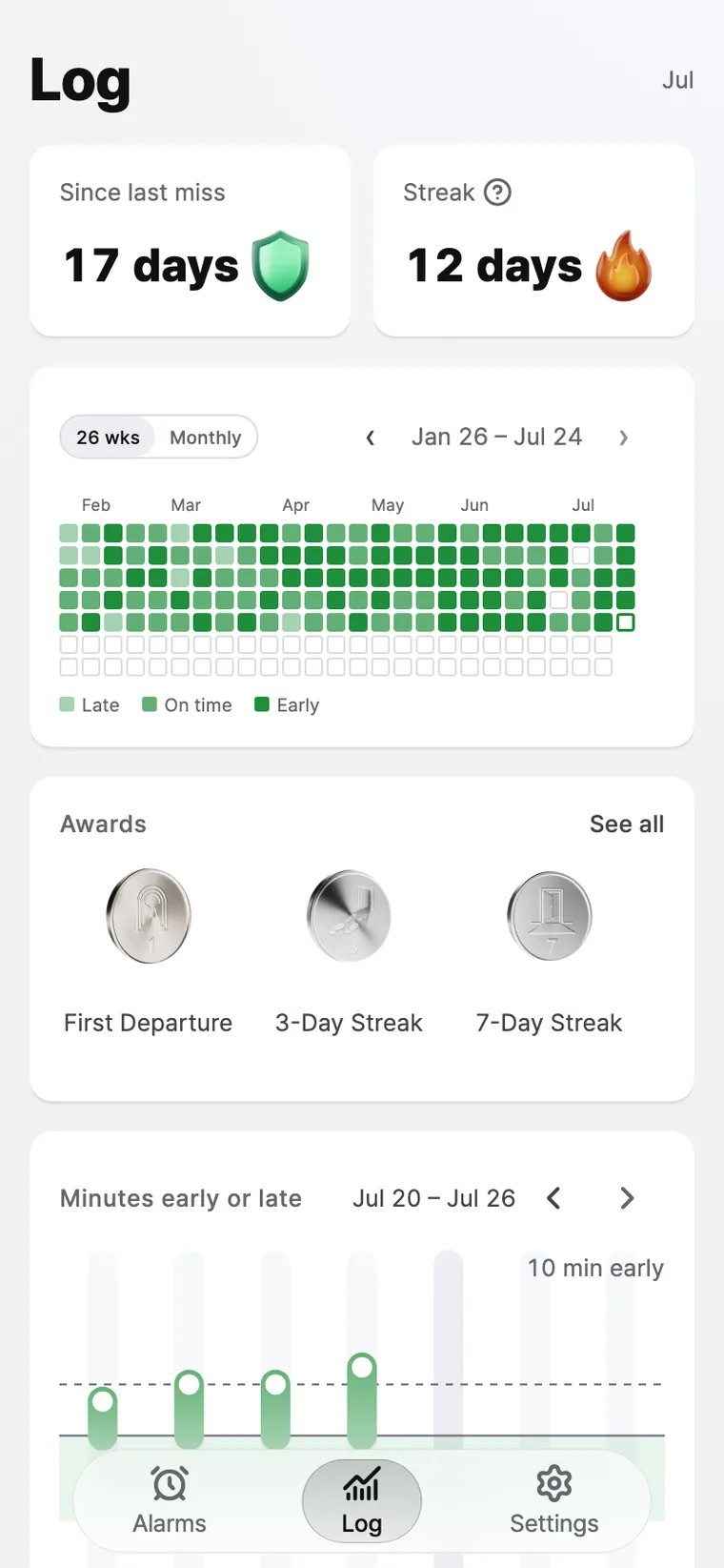
Your record · measured, never typed in
Not just whether you left. How consistent you've become.
You already wake up at about the same time every day. It's the time you leave that drifts: 8:04, 8:19, 8:31. Run Late tracks that spread, because that's the number that decides whether you're late.
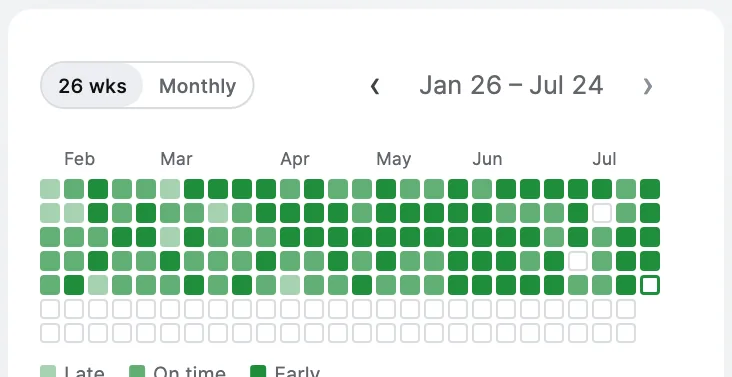
26 weeks
One square per day, filled in only when GPS confirmed you left. Nothing here was typed in.
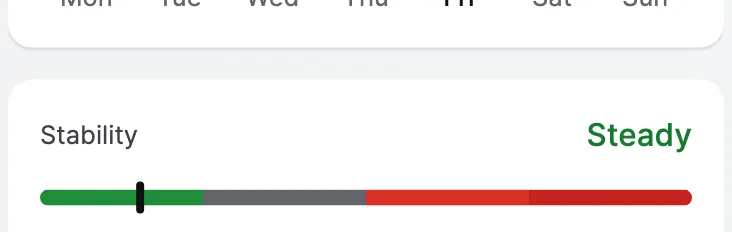
Departure stability
The spread of your last ten departures. Steady means you now leave at about the same minute every day.
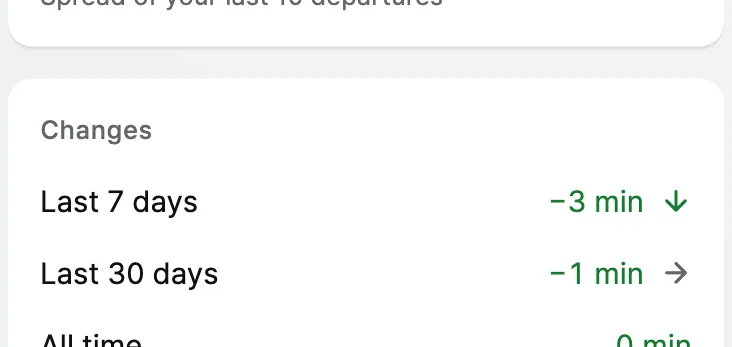
Changes
Last 7 days, last 30, all time. Progress you can read as a number, not just a feeling.
You can outlast the sound. You can't outlast the record.
Everything that gets you
out the door
Three that do the work. Five that stay out of your way.
Your departure time
Most people have never seen the exact minute they need to leave. Run Late figures it out and keeps it on your lock screen.
No off button
No snooze. No dismiss. Nothing to tap. Quiet while you move, loud when you stop.
Proof you left
Every departure is measured by GPS, not typed in. Your streak, your on-time rate, and the days since you were last late.
On your wrist
Leave your phone in your pocket. On iPhone, your departure card shows up in the Apple Watch Smart Stack on its own.
Heads-up at 15 and 5 minutes out
Two quiet nudges before your departure time. Then the alarm.
Two missions
150 feet on the map, or 50 steps with the camera on your path, which helps where GPS is weak.
Skip today
Tap the alarm's switch and choose Skip today before it fires. A skipped day is data, not a punishment.
Your own voice
Record any sound and the alarm plays it. Whatever gets you out the door.
It was never a willpower problem.
Being late isn't random. It runs on a few laws, and willpower doesn't change them. What does is enforcement: one if-then plan, set in advance. When the alarm rings, you walk out.
One if-then plan beats more motivation.
Motivation alone38%
One if-then plan91%
Motivation alone added nothing: the same follow-through as the control group. One if-then plan nearly tripled it, and across 94 studies the effect holds at d = 0.65.
Getting ready and getting there take 40 to 60% longer than you plan. That's the planning fallacy, not a character flaw.
Kahneman & Tversky (1979) · Buehler et al. (1994)
77 seconds
A minute is not a minute.
If you're chronically late, a minute feels like 77 seconds. Your sense of time runs slow, and not by choice.
Conte, San Diego State University
47%
Meaning to isn't doing.
Across 422 studies, 47% of people with a firm intention still didn't follow through. Knowing what to do was never the problem.
Sheeran (2002), meta-analysis of 422 studies
Run Late runs that plan for you. It rings at your departure time on the days you choose, until leaving on time stops being a decision.
Run Late is not affiliated with or endorsed by these researchers or institutions. All findings cited are from publicly available research.
Become the person
people can count on.
Every on-time arrival adds up. You become the one who's already there when it starts, the one nobody has to worry about.
Honest billing.
You see the exact date you'd be billed before you subscribe. We remind you two days before. Nothing is due until then. Cancel anytime.
Before you ask
Is Run Late a wake-up alarm?
No. It's a departure alarm. It rings at the minute you have to leave, and it only stops once you're outside.
How do I stop it?
There's no off button and no snooze. Walk 150 feet outside, or take 50 steps with your camera pointed at the path.
Why does it need my location?
Run Late reads your location once when you set your home, and otherwise only from the moment the alarm fires until the mission is complete. That's the only way to measure a departure instead of taking your word for it.
What about a day I stay home?
Tap the alarm's switch and choose Skip today before it fires. A skipped day is data, not a punishment.